
Concept Statement:
“This is what rituals are for. We do spiritual ceremonies as human beings in order to create a safe resting place for our most complicated feelings of joy or trauma, so that we don’t have to haul those feelings around with us forever, weighing us down.” – Elizabeth Gilbert
Architecture has always been humanity’s attempt to create sacred containers for our most profound experiences. These five photographs explore how built spaces become vessels for ritual, from the intimate daily practices that anchor us to the communal ceremonies that bind us across generations. Each image captures a moment where space transcends function to become a sanctuary for the human need to pause, reflect, and connect.
In Nigeria, as in cultures worldwide, our architecture tells the story of how we seek the sacred in both the monumental and the mundane. These spaces, whether ancient or contemporary, grand or humble, serve as “safe resting places” where our rituals can unfold, where we can set down the weight of existence and remember what it means to be human.
Artist Statement:
As an architectural designer and visual storyteller, I am drawn to the spaces where the sacred meets the everyday. These photographs were captured across Lagos and Ibadan in Nigeria, each representing a different scale of ritual practice, from the personal to the communal, from the daily to the generational.
What fascinates me is how architecture serves as both stage and participant in our rituals. These spaces don’t just house our ceremonies; they shape them, inform them, give them meaning through proportion, light, materiality, and memory. They become the “safe resting places” Elizabeth Gilbert describes as containers strong enough to hold our most complex emotions and experiences.
In a rapidly changing world, these architectural witnesses remind us that some human needs are constant: the need for sanctuary, for community, for connection to something larger than ourselves. Whether carved from ancient stone or shaped from modern concrete, these spaces continue to serve their most essential function, creating room for the human soul to breathe, to remember, to belong.
Through this photo essay, I invite viewers to consider: What are the spaces that hold your rituals? What walls have witnessed your transformations? And how do the places we build continue to build us in return?

Every morning, someone walks this corridor. Perhaps a caretaker arriving before dawn, footsteps echoing against stone. Perhaps a worshipper seeking solitude before the day begins. The interplay of light and shadow creates a natural timekeeper, marking the hours, the seasons, the cycles that govern our daily rituals. This is architecture as calendar, space as sacred time. The geometric patterns speak of Islamic traditions, where repetition becomes meditation, where walking becomes prayer.
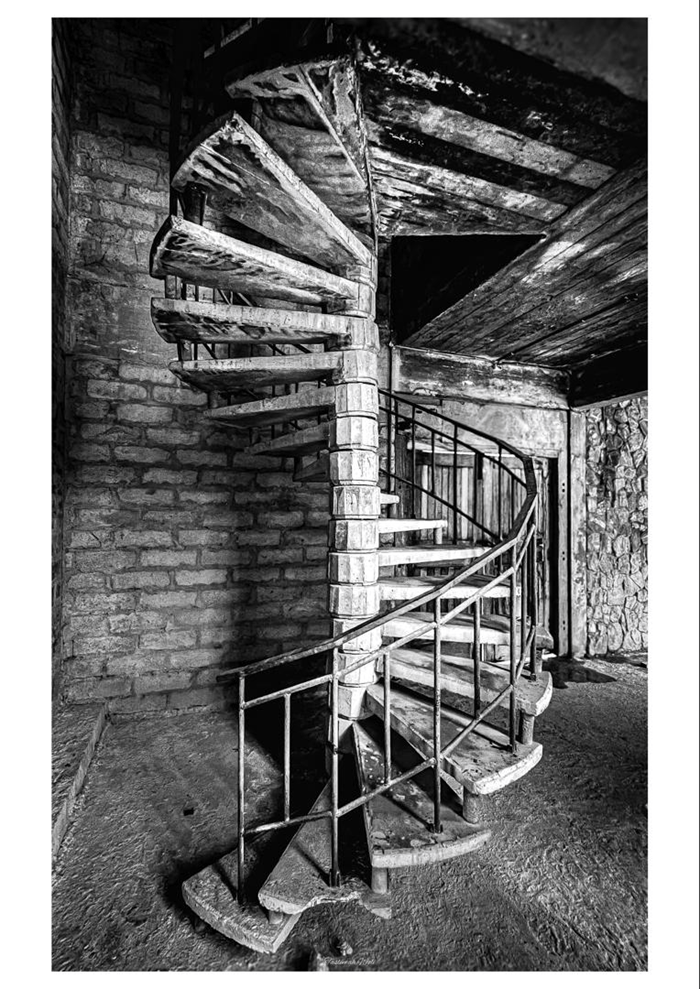
Climbing is humanity’s oldest ritual of transformation. From the ziggurats of Mesopotamia to the minarets of West Africa, we have always built upward as a way of reaching inward. This spiral staircase embodies the circular nature of ritual time; we ascend, but we also return, each revolution bringing us closer to something ineffable. Someone climbs these steps daily: the muezzin calling prayer, the student seeking knowledge, the believer pursuing transcendence. Each step is both departure and arrival.

This is where people gather in the spaces between. Before the ceremony begins, after it ends, and in the quiet moments when the community forms naturally. The repetitive arches create rhythm, like breathing, like heartbeat, like the call and response of communal prayer. This is architecture that understands ritual as social practice, that provides shelter not just for bodies but for the conversations that weave communities together. Here, rituals are not just performed but prepared for, reflected upon, and carried forward.
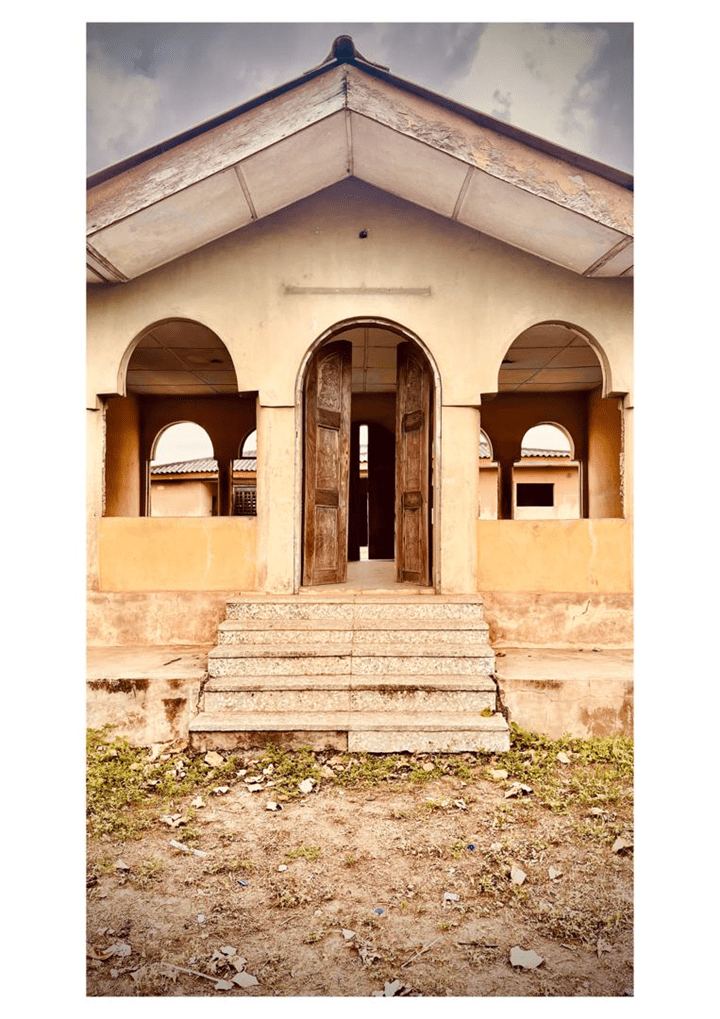
Some walls have witnessed centuries of ritual. Birth celebrations, coming-of-age ceremonies, marriage rites, and funeral processions all have passed through these archways. The weathered surfaces tell stories of hands that have touched them in blessing, tears that have stained them in mourning, and laughter that has echoed off them in celebration. This is ritual architecture in its most enduring form: spaces that outlive the individuals who built them, becoming repositories of collective memory.
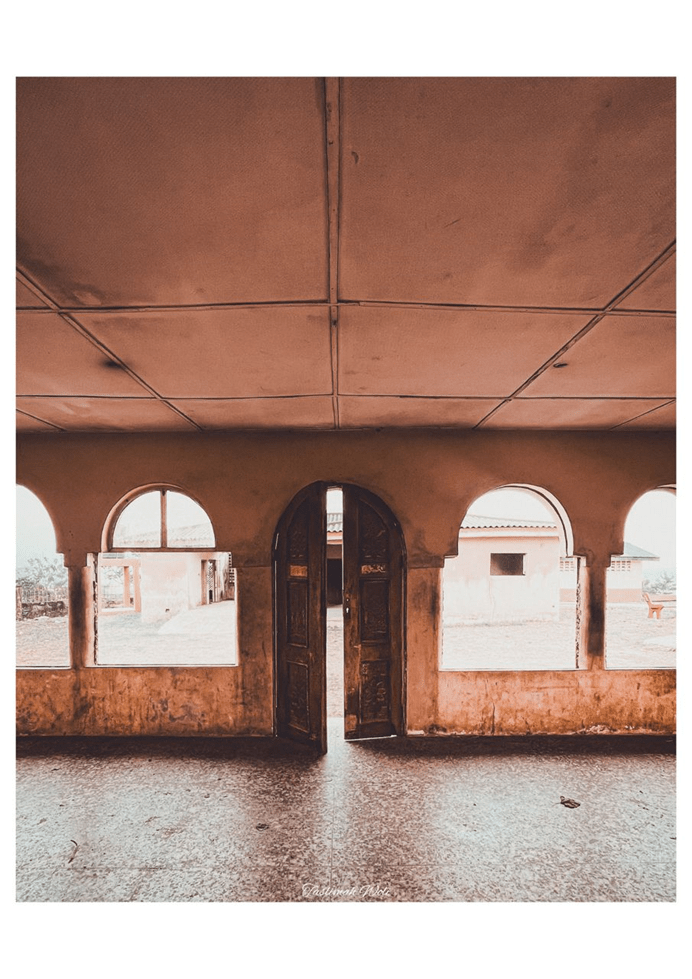
Perhaps the most profound rituals happen in the simplest spaces. This could be where someone prays five times daily, where a family shares evening meals, or where elders pass down stories to children. The golden light suggests the sacred hour, that time when day becomes night, when the ordinary briefly touches the eternal. This is architecture stripped to its essence: four walls, a roof, and the infinite potential for human connection with the divine.
About the artist:
Taslimah Woli is a Nigerian architectural designer and visual storyteller whose work explores the intersections of space, memory, and human experience. She earned a First-Class degree in Architecture from the University of Ilorin and is deeply interested in how design reflects the quiet negotiations of everyday life.
Her photography began intuitively as personal documentation but quickly evolved into its own visual language. Through her lens, Taslimah captures overlooked buildings on the verge of erasure, textures that tell stories, and corners where light reveals hidden narratives. Her photo essay has been published on Lolwe. She is less interested in spectacle and more in the kind of beauty that invites contemplation.
Rooted in empathy and reflection, her work is shaped by her architectural training, her love for cities, and her belief that design and photography can serve as both mirror and memory.
 Isele Magazine