
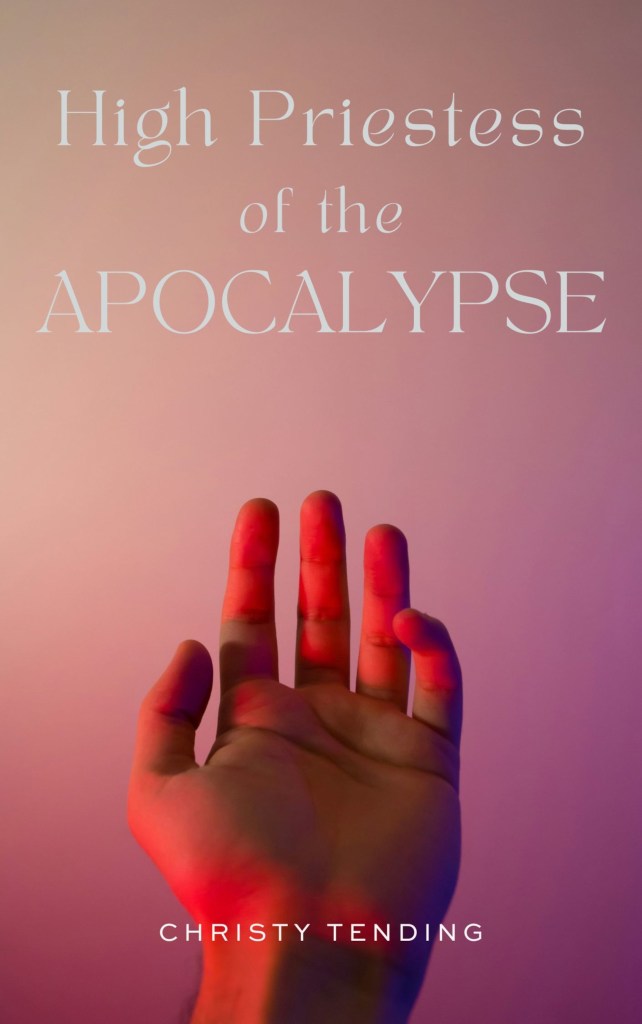
“This is a memoir, not a map of where the bodies are buried,” writes Christy Tending, in High Priestess of the Apocalypse. “It’s about wringing out everything into the sink and watching what floats to the surface.” In Tending’s case, what floats to the surface is simultaneous grief and hope. As High Priestess of the Apocalypse grapples with the future of a planet impacted by climate change, so too does the author and climate activist grapple with the impact, the collisions, as well as the moments of relief she has felt herself.
Court Ludwick: In the introduction of your book, you pose the questions: “How do we meet the feeling that the world as we know it is ending? How do we maintain compassion for ourselves in the midst of grief and chaos? How do we inspire ourselves to action in the face of hopelessness designed to keep us complacent?” How does compassion find its way into your writing? Into your writing practices?
Christy Tending: I’ve been a Buddhist practitioner for more than 20 years now, and loving-kindness meditation is my core practice in that tradition. I’ve come to understand compassion as central to my writing practice—or even a prerequisite. As a memoirist and essayist, I find that I can’t write about a particular experience accurately or with nuance until I’ve found compassion for myself and the role that I played in that situation. Similarly, I try to develop compassion for everyone involved to some extent before I try to write about them. I’m never writing to settle a score, so sometimes I have to wait a long time to write about an experience so that I can write from that compassionately neutral place. I want to make sure that I’m as settled as I can be about something before it makes its way to the page. I also have to forgive myself for things before I can write about them in a way that’s truthful.
CL: Was there a piece in the collection where finding this compassion was more challenging? How do we reach this point of compassion for those individuals upholding structural and systemic violence themselves?
CT: In the book, I often had to confront myself and certain decisions that I’ve made and find compassion for why I made those decisions. The answer is always, “I made the best decision I could with the information available at the time.”
I definitely have the most trouble finding compassion for police and those who are imposing state-sanctioned violence on vulnerable populations. I don’t think there’s a detente to be reached between us, really, when I personally believe that no one should be a cop. But I try to stay focused on dismantling the systems themselves rather than trying to convince the individuals who are invested and deeply benefit from those systems.
It’s just not a great use of my time, on a strategic level.
CL: In a previous interview, you’ve said that “The very first sentence I wrote for the book was, ‘I keep thinking about violence.’” How has your conceptualization of violence developed or changed since beginning to write this book?
CT: That line was so important because it led me down all of these other paths, not just in that one piece but in all of these other areas of my life. I could see how violence has been a part of so many of my life experiences and really colors the way that I see the world.
The concept of violence is something I’m engaging with on a pretty regular basis. What does it mean to be violent versus nonviolent? I’m always interested in applying more nuance to the conversation than the binary between violence and nonviolence. I see it get tossed around rather carelessly, especially when it comes to how activists are portrayed in the media. And I’m interested in implications, not just on a tactical level, but a strategic one about what violence truly means and who gets to use it with impunity.
Right now, I’m thinking about the ways that, as an idea, the word “violence” is often weaponized against those who dare to challenge norms and power structures. I’ve been thinking a lot about who has the privilege and right to wield the word. Somehow, the act of students setting up encampments on college campuses is seen as egregiously “violent,” but the deaths of tens of thousands of children in Gaza is not seen as sufficiently violent that the US government feels it should make any move to stop aiding and abetting it.
CL: What other binaries do you see your work confronting and dismantling? Are there any binaries that are harder to escape than others?
CT: In general, when I encounter binaries, I try to ask: what if that weren’t true? Humans like to categorize themselves, often into binaries. Some of them are pretty innocuous (coffee drinkers vs. tea drinkers), but some of them are quite dangerous. I think gender binaries create a huge amount of harm. And I just try to question, as often as possible in my writing, what if it weren’t that simple? What possibilities open up to us when we don’t insist on binaries?
CL: Do you have any thoughts on how writers might be positioned to navigate the often violent world we live in? How might writing counter-act violence?
CT: I think that storytelling is one of the most powerful tools we have to navigate and dismantle violent systems. By conveying the realities of what we’re up against, we can express what’s at stake and help those who are struggling to feel less alone. It’s rarely the cut-and-dry facts that change peoples’ minds, it’s the stories of what real people are experiencing that help people develop the courage to take action and claim their power.
Writers have a capacity, and therefore a responsibility, to use our words in service of collective liberation.
CL: What is your relationship to structure?
CT: People tend to think that as an anarchist, that I don’t like structure. But I’m also a Virgo moon, so I actually love structure.
For me, structure is made to be reimagined. I love to borrow and then break apart structures in creative ways. I find, as a direct action trainer, that often we can use old, predictable structures to teach new ideas more easily. The structure feels familiar and can help us make new, challenging ideas more legible.
Structure can mean a lot of things. What I actually rebel against when it comes to structure is the way so many of our country’s current structures reinforce hegemonic and unjust systems of power. It’s not structure itself, but the way that structures are designed to reinforce hierarchy and further disempower those who are historically marginalized.
CL: Could you speak a bit to how anarchy and writing intersect for you?
CT: My writing is really an extension of the way that I practice anarchism. Of course, I want my writing to reflect my values, so sometimes I’m writing explicitly about direct action and mutual aid, which are core anarchist practices. Or sometimes the writing advocates for a very particular political position, like prison abolition or climate justice. But at its most successful, I like to think that my writing reminds people of their interconnection to one another and to their innate power—and ability to shift power if they organize. It goes back to what my goals are for writing: to make others feel less alone and to bring truth to light. Those are my goals with my political practice as well, as an anarchist.
To me, both writing and anarchism are practices of imagination. How could the world be different? What would it feel like if people were trusted to govern themselves and to care for one another deeply? Who could we be, collectively, if we set down our exceptionalism and hyper-individualism and embraced mutual aid?
CL: You use structure in compelling ways, particularly in hybrid pieces like “Arrestee Support Form” and “What to Bring.” How do you navigate structure in your writing—especially considering the often fragmentary nature of trauma, of trauma representation in memoir?
CT: I love playing with structure and offering myself the benefit of hybrid forms that can serve as scaffolding for writing some of the more difficult moments. It offers a different framework that lets me approach the moments of trauma without just strip-mining those moments for maximum shock value.
Sometimes, it’s hard for me to get close enough to the moments I’m trying to write about without it being damaging or feeling overwrought. It’s not good for me or for the writing!
I don’t want to veer into melodrama, and borrowed forms help bring some play back into those pieces and it gives people a familiar framework (like filling out a form or a packing list) that I can then fill in an unexpected way. Those pieces were some of the most fun to write. To me, they feel in some ways like the connective tissue of the book, because both the form and its contents reveal something about the life I’ve lived. One without the other kind of flattens the experience.
In some cases, those pieces also offer insight into the nature of the work itself: what it’s like to be an activist in an ongoing way, and the ways that these structures become second nature.
CL: What is your relationship to absence?
CT: Ironically, absence is all around me. I’ve been in a grieving process for the last six months and am still navigating my relationship to the absence of this person. We had a difficult relationship in life and that hasn’t changed much in absence.
There’s an inherent grief to being a human because everything and everyone is impermanent. I’m personally always in a state of missing a person or a place. I’m from someplace other than where I live. My loved ones are scattered everywhere. I’ve grieved a lot. I think so much of my writing is just an ongoing attempt to gather all of that love into a single place for once.
There are certain people or memories or places or experiences that I’m always carrying around with me, though: you may not see them, but they’re inextricable from my process. My grandmother is always looking over my shoulder. She may be absent, physically, but I still very much feel accountable to her.
CL: Becoming more aware of this impermanence—acknowledging the constant change that the human condition necessitates—feels like it might be generative in terms of leading to healing, to change itself…did writing this book change you? Or, is there a specific piece in the collection that you feel brought about the most change for you as a writer?
CT: I think writing the book has changed me, and has certainly changed my perspective on things. There are things, because they’re in the book, that I don’t have to keep re-litigating in my brain. Those things feel more settled, somehow, and I don’t have to go back to them. There are definitely certain inflection points in the book where writing the piece changed both the course of the book and who I am as a person. “The Trouble With Little Violence” is one piece that I never thought I would write, but writing it has absolutely changed my relationship to that experience and me as a person.
CL: You write often of motherhood, and the tender moments between you and your child in the latter half of High Priestess of the Apocalypse are some of my favorites. Have you broached the subject of climate change with your child? If so, how?
CT: We talk about climate change all the time in our home. My child, for better or worse, has a really strong understanding of climate change, justice issues, and what’s at stake. I try to frame things in a positive way: “Here’s what we’re trying to save,” or “Here’s the world we want to build.” I think that’s an easier way for kids to conceptualize things. And it motivates him to think about solutions.
At his age, I am trying to help him cultivate a relationship with the natural world that is curious and reverent. I could lecture him all day long about the science of climate change, but I want him to also enjoy the world and to allow that love for the world to propel him in what he will do with his life. At the moment, he wants to be a part-time paleontologist and a part-time Antarctica scientist, and that feels about right. It’s very him.
CL: Your book’s final moments are heartbreaking yet hopeful: “This is how we move through the beginning of the end of days. This is how we bear witness to the slow unraveling. I will hold all of it with both hands. One for soothing, one to fight. I will take your abandoned cats, I will absorb your broken dreams.” And time seems to be a central focus here. What is the role of time in your writing—and in your work as a climate activist?
CT: Time is something that I love to play with, as a writer. As writers, one of our greatest superpowers is that we get to bend time. Two or more things can be true—and occurring—at once. I am here at my computer, in California, yes. But I am also riding through the backwoods of Maryland on my pony at 16. And I am also working to conceptualize and build the word that my child is going to live in when he grows up. I get to live in these multiple timelines simultaneously.
Children have this magical ability, too: they can stretch an afternoon into a lifetime and make a year go by in the blink of an eye.
I think I sometimes get too caught up in urgency. As an activist, as a writer, wanting to leave it all on the field. Rushing to the next thing. I’m trying to let things marinate for longer. I’m trying to let myself take intentional action rather than quick action. Sometimes, if you want to make a deeper impact, you need to think about your own long-term sustainability, in addition to doing the rapid response kind of work.
CL: Time tends to lure me into this trap of urgency, too. What have you found has helped in this regard—do you have any practices (writing or otherwise) that help you slow down and focus on intentional action?
CT: I try to let it all be a part of the process, in terms of my writing. Reading books, going for walks, making myself a meal, sitting in meditation, watching my child play. My brain is always noodling on something in the background. So I don’t need to create false urgency when I sit down to write. Often, when the idea is ready, it will kind of pour out of me. I just need to create the conditions for it to simmer.
When it comes to taking action on a political level, I try to do one thing every day. It doesn’t have to be big, but it keeps me searching for ways that I can amplify or participate in something that’s solution oriented, which helps to keep me out of despair.
CL: What are you working on now?
CT: There’s another book waiting for me. I’m approaching my next project very gingerly. I haven’t settled on the structure quite yet and I’m trying to let her show me what she wants to be. I’m in the process of writing into a bunch of ideas and waiting to see what, if any of it, wants to stick around and become part of the new thing. We’ll see. It’s been a long time since I’ve been this uncertain about what a project is trying to be so I’m trying to be patient. But of course, it still centers on so many of my favorite themes: climate, place, memory, grief, family. It’s still very me!
About the Authors:
Court Ludwick is the author of These Strange Bodies (ELJ Editions, 2024) and the founding editor-in-chief of Broken Antler Magazine. Her writing has been nominated for Best of the Net and the Pushcart Prize, and can be found in EPOCH, Denver Quarterly, Oxford Magazine, West Trade Review, and elsewhere. She has an MA from Texas Tech University and is a current PhD student at the University of South Dakota, where she also teaches literature and composition. Find Court on socials @courtludwick. Find more of Court’s writing and art on http://www.courtlud.com.
Christy Tending is a writer, mama, and climate justice direct action organizer. A creative nonfiction editor at Sundog Literary, her work has appeared in Longreads, The Rumpus, Newsweek, and elsewhere. Her work has been nominated for the Pushcart Prize and Best Microfiction, and received a notable mention in Best American Science and Nature Writing 2023. She lives in Oakland, California with her family. She can be found at www.christytending.com.
 Isele Magazine